
• About
  • Advertise
  • Subscribe
  • Contact
  • Events
Thursday, April 16, 2026
Newsletter
SUBSCRIBE
  • News
    • Events
  • Features
  • Electricity
  • Gas
  • Renewables
    • Batteries & Storage
    • Hydro Power
    • Hydrogen
    • Solar
    • Wind
  • Smart Energy
No Results
View All Results
  • News
    • Events
  • Features
  • Electricity
  • Gas
  • Renewables
    • Batteries & Storage
    • Hydro Power
    • Hydrogen
    • Solar
    • Wind
  • Smart Energy
No Results
View All Results
Home News

How do Australia’s energy prices compare with international counterparts?

by April Shepherd
February 4, 2022
in Electricity, News, Retail, Spotlight
Reading Time: 3 mins read
A A
Share on FacebookShare on Twitter

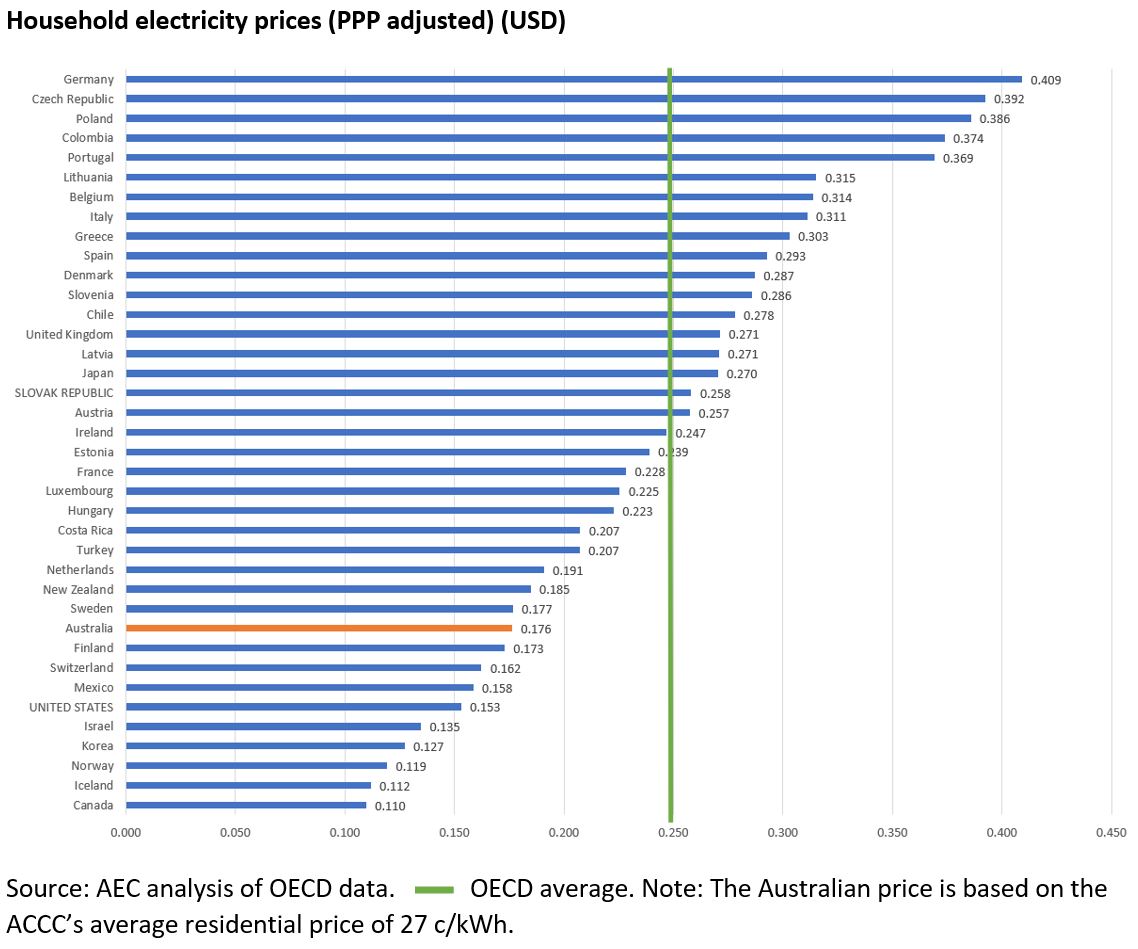
The Australian Energy Council (AEC) has revealed where Australia’s energy prices sit amongst fellow Organisation for Economic Co-operation and Development (OECD) nations, discovering the country has the tenth lowest retail household electricity prices out of the international organisation. 

The AEC analysis also showed that Australia’s retail household electricity prices in the National Electricity Market (NEM) are the lowest they have been for eight years. 

Australian prices are based on the average cost per unit of electricity of 27 cents per kilowatt-hour reported by the Australian Competition and Consumer Commission (ACCC) in its most recent NEM review.

The AEC’s Chief Executive, Sarah McNamara, said, “This assessment of how much Australian homes and businesses pay shows our electricity supply is internationally competitive, and that retailers are passing savings on to customers.

“Consumers have been benefiting from lower wholesale prices which have been flowing through to household bills.

“The competitive retail market is also helping keep electricity costs down with market offers offering better value than the regulated default offers set by the government.”

When compared against other OECD countries, based on an equivalent purchasing power index for prices, Australian average prices per kilowatt-hour (kWh) are equivalent to 17.6 US cents (c/kWh), well below the OECD average cost of 24.2 US c/kWh and less than many European countries on a Purchasing Power Parity (PPP) basis.

PPP is used to adjust the data to exchange rate differences and ensures a like-for-like comparison when buying equivalent goods or services across borders. A PPP can therefore provide a good indication of affordability by country.

The highest household cost of electricity on this basis is in Germany, the Czech Republic, and Poland, while the cheapest residential electricity rates are seen in Canada, Iceland, and Norway.

Without the PPP adjustment, Australian residential electricity prices are at 19.21 US c/kWh, just below the OECD average (19.8 US c/kWh).

“Whilst this is encouraging news for all Australian consumers, it’s still a good idea to speak to your retailer or look on the government-run comparator sites (Energy Made Easy and Victorian Energy Compare) and to make sure your retail deal is the best value for your circumstances,” Ms McNamara said.
More details of the analysis can be found here.
Related Posts

Geelong refinery

Geelong oil refinery ‘still producing’ despite fire

by Tom Parker
April 16, 2026

Federal Minister for Climate Change and Energy Chris Bowen says Viva Energy’s oil refinery in Geelong continues to produce diesel...

battery discharge

NSW, NEM smash battery discharge records in single day

by Tom Parker
April 14, 2026

Batteries are getting to work in NSW and the National Electricity Market more broadly, with a host of new discharge...

negative electricity prices

SA and Victoria notch negative prices for almost four days

by Tom Parker
April 14, 2026

South Australia and Victoria both experienced negative average wholesale electricity prices from late on April 8 into the evening on...

Read our magazine

Join our newsletter

View our privacy policy, collection notice and terms and conditions to understand how we use your personal information.
Energy is a thought-leading, technology-neutral magazine, developed to help the industry answer some of the Energy sector critical questions it is currently grappling with.

Subscribe to our newsletter

View our privacy policy, collection notice and terms and conditions to understand how we use your personal information.

About Energy

  • About
  • Advertise
  • Subscribe
  • Events
  • Contact
  • Digital Magazine
  • Terms & Conditions
  • Privacy Collection Notice
  • Privacy Policy

Popular Topics

  • News
  • Spotlight
  • Renewable Energy
  • Electricity
  • Projects
  • Networks
  • Sustainability
  • Gas

© 2026 All Rights Reserved. All content published on this site is the property of Prime Creative Media. Unauthorised reproduction is prohibited

No Results
View All Results
NEWSLETTER
SUBSCRIBE
  • News
    • News
    • Events
  • Features
  • Electricity
  • Gas
  • Renewables
    • Renewables
    • Batteries & Storage
    • Hydro Power
    • Hydrogen
    • Solar
    • Wind
  • Smart Energy
  • About
  • Advertise
  • Subscribe
  • Contact
  • Events
  • Newsletter

© 2026 All Rights Reserved. All content published on this site is the property of Prime Creative Media. Unauthorised reproduction is prohibited